The Engineering Behind the Feeling: How Dolby Tunes Every Seat in Mahindra's Electric SUVs
Great sound rarely happens by accident. Ask any recording engineer, and they will tell you that a mix that feels perfect in one room can fall completely flat in another. The size of the space, the material on the walls, the position of every speaker relative to the listener, all of it shapes how music actually reaches the ear. A car cabin is no different. In fact, it may be one of the most demanding rooms an engineer will ever mix for.
Every vehicle has its own acoustic fingerprint, shaped by glass, seating, headroom, and the geometry of the cabin itself. That is precisely why turning a car cabin into a genuinely immersive audio experience takes far more than adding a few extra speakers. It takes a full understanding of the science behind the sound, and the science behind the picture, so that once you have felt entertainment this way, an ordinary drive starts to feel like something is missing. Here is how that science comes together, seat by seat, inside Mahindra's Electric Origin SUVs.
Designing the Cabin
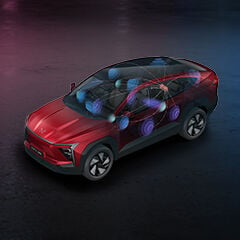
Long before a single note plays, the cabin itself is being engineered for sound. In Mahindra's Electric Origin SUVs, the front doors carry three-way speakers with a dedicated tweeter, mid-range driver, and woofer, while the centre channel uses a patented Unity Speaker design for clearer dialogue. High-fidelity speakers handle the rear, a subwoofer anchors the low end, and ceiling-mounted drivers add height overhead, all working together across a 16-speaker Harman Kardon system.
Cabin materials matter just as much as speaker count. The fabrics on the seats, the trim on the doors, and the shape of the dashboard all influence how sound waves reflect, absorb, or scatter. A genuine premium car audio system has to account for every one of these surfaces. Electric SUV technology adds an unexpected advantage here too. Since there is no engine noise masking the details, every acoustic imperfection, and every acoustic strength, becomes far more apparent. The EV cabin experience essentially raises the bar for what "quiet" and "clear" need to mean.
Tuning the Experience
Hardware alone does not create an immersive audio experience. This is where system-level engineering comes in. Dolby's Car Experience is designed to integrate directly with a vehicle's head unit and digital signal processing (DSP) architecture, rather than being layered on top of it. Dolby Atmos in cars requires speaker configuration, system integration, and cabin tuning to work in concert. This is exactly why the Dolby badge on a dashboard represents something specific and engineered, not just a marketing label.
For Mahindra's Electric Origin SUVs, that tuning process brought together Dolby's audio engineers with Harman Kardon's hardware expertise, and something more personal: the artistic ear of composer A.R. Rahman. Rahman worked closely with the development team to shape curated sound modes like Calm, Cozy, and Club, plus dozens of smaller sonic details most owners will never consciously notice, but will always feel. It is a reminder that great in-car technology is equal parts engineering discipline and artistic instinct. The result is what Mahindra calls its Sonic Studio Experience, a Mahindra immersive audio experience built for the geometry of these cabins, not adapted from somewhere else.
World-Class Sonic (and Visual) Experiences
None of this engineering matters if owners cannot easily step into it. To understand why it feels so different, it helps to know what Dolby Atmos actually does. Sound mixed in standard stereo is locked into two channels, left and right. Dolby Atmos frees sound from channels altogether, letting engineers place each individual element - a vocal, a guitar line, a rustling leaf, as its own object in three-dimensional space. Inside the Mahindra infotainment system, Dolby Atmos Music streams through Gaana. The system decodes the placement of individual elements across the cabin's 16 speakers, so a favourite track does not simply play from the dashboard, it moves around the seat, overhead included. Look for the Dolby badge within the app to know a track is delivering the full spatial sound experience in cars, not a standard stereo mix.
Picture works on a similar principle. Dolby Vision combines high dynamic range imaging with a significantly wider colour palette than a standard display, using the same production pipeline filmmakers rely on for cinema and premium television, not a scaled-down version built for a smaller screen. Highlights can appear dramatically brighter, blacks noticeably deeper, and colours truer across the full brightness range, adding a genuine sense of depth to every frame. Paired with content from platforms like Sony LIV, this turns charging stops and parked breaks into moments of real cinematic in-car entertainment.
Experiencing it is simple: look for a cabin enabled with Dolby Vision and Dolby Atmos, seek out the badge within apps like Gaana and Sony LIV to know the content itself was created in Dolby, then let the digital cockpit handle the rest, calibrating brightness and matching the picture to the Atmos soundstage automatically.
Future Possibilities
Because this is a software-defined vehicle, the experience is designed to keep improving. Over-the-air updates mean today's advanced infotainment system is a starting point, not a finished product. Future OTA enhancements can bring new sound profiles, refined tuning, and an expanded content ecosystem as more platforms adopt Dolby Atmos and Dolby Vision for automotive.
This is the deeper story behind SUV buying trends that increasingly favour experience over spec sheets: the future of automotive technology, defined by how thoughtfully every seat, material, and line of code was tuned for the people sitting inside.
A great in-car experience always looks effortless from the driver's seat. That is precisely the point. Behind every seamless moment sits a recording engineer's discipline, applied not to a studio, but to a smart electric SUV built to feel like one. Step inside, press play, and it becomes obvious: this is not something you simply watch or hear anymore. It is something you feel.
News and Press Releases
10 February 2026
Mahindra Scales Up Aftersales Service...
Mahindra Scales Up Aftersales Service Operations in Delhi NCR

14 January 2026
Mahindra XEV 9S and XUV 7XO record 93,689 Bookings
Booking Value of over ₹ 20,500 crore (*at ex-showroom price)

04 July 2025
Mahindra to Commence Deliveries of BE 6 and XEV 9e Pack Two from End-July
Now with both 59 kWh and 79 kWh battery options

9 Apr 2025
Mahindra Delivers 3000 All-Electric Origin SUVs Across India
Overwhelming response for both XEV 9e and BE 6
14 Feb 2025
Mahindra Electric Origin SUVs create new record in the EV category securing 30 179 bookings on day 1
Registered a booking value of ₹ 8472 crores (at ex-showroom price)

5 Feb 2025
Mahindra eSUVs to open bookings from 14th Feb, 2025
9 variants of the XEV 9e & BE 6 to be available for booking

14 Jan 2025
BE 6 makes its gaming debut in BGMI
KRAFTON X Mahindra redefine virtual engagement for gamers

7 Jan 2025
Prices for XEV 9e & BE 6 top variants announced
Test drives to begin from 14th January in select cities
7 Dec 2024
Mahindra to contest brand rights of BE 6e in court
Meanwhile, to name its Electric Origin SUV “BE 6”

29 Nov 2024
Unprecedented Safety of Mahindra eSUVs Demonstrated
Showcased: Live EV Crash and Battery Torture Tests

29 Nov 2024
Sonic Studio Experience by Mahindra
Immersive in-cabin audio experience in BE 6e & XEV 9e
26 Nov 2024
Mahindra's Electric Origin SUVs launched at Unlimit India
XEV 9e starts at Rs. 21.90 Lakh and BE 6e at Rs. 18.90 Lakh

22 Nov 2024
Mahindra Teases Sketches of BE 6e & XEV 9e
World Premiere at UNLIMIT INDIA, on 26th November in Chennai

21 Nov 2024
INGLO: Mahindra’s Electric Origin Architecture
XEV 9e & BE 6e World Premiere on 26th November in Chennai

04 Nov 2024
Mahindra debuts Electric Origin SUVs Named XEV 9e and BE 6e
World Premiere at UNLIMIT INDIA, on 26th November in Chennai

8 Jan 2025
New state-of-the-art EV manufacturing facility unveiled in Chakan
Next-gen EV plant to be dedicated for EV manufacturing & battery assembly