Why Your Next Car’s Best Feature Could Be Its In-Car Entertainment System
Consumers today are already well acquainted with immersive entertainment. They experience spatial audio on their smartphones and headphones, have access to high-quality streaming on televisions as well as increasingly sophisticated digital experiences across connected devices. Even Dolby Atmos Music is already available through streaming services.
Having said that, a car is arguably one of the most compelling environments for premium entertainment. People spend significant amounts of time inside their vehicles. At the same time, a car offers a relatively controlled acoustic environment and increasingly capable displays, processors and connectivity.
As cars become connected, software-defined and increasingly digital, in-car entertainment is emerging as a serious innovation frontier. Consider a simple scenario. You are driving a Mahindra SUV, select a Dolby Atmos song on Gaana, and press play. What happens next is considerably more sophisticated than simply sending music to the car’s speakers.
The music has been created and mixed in Dolby Atmos, with individual elements of the track positioned within a three-dimensional sound field. The streaming service delivers that content. The car’s connected infotainment architecture receives and processes it. And the vehicle’s audio system, carefully engineered around the cabin, renders those sounds so that vocals, instruments and effects can appear to occupy different positions around you.
The result is not simply louder or higher-quality music. It is an immersive audio experience that makes the cabin feel less like a place where entertainment is consumed and more like an entertainment environment in itself.
From stereo sound to a three-dimensional experience
Traditional car audio is largely based on channels: left, right and, in more advanced systems, additional surround channels. Dolby Atmos takes a different approach. Rather than restricting individual sounds to fixed channels, it allows audio elements to be positioned and moved within a three-dimensional sound field, including above the listener.
What is Dolby Atmos? What makes it superior?
Dolby Atmos is an immersive audio technology that creates a three-dimensional sound field by precisely positioning sounds around and above the listener. Compared with traditional stereo or surround sound, it delivers greater immersion, spatial precision, height, depth and separation, making music, films and sound effects feel more natural and lifelike. In an SUV, Atmos can create a wider, more enveloping soundstage, making the cabin feel acoustically much larger.
That distinction is particularly interesting inside a vehicle. A premium car audio system is no longer simply about adding more speakers. The challenge is to understand the acoustics of a specific cabin and reproduce the creator's intent consistently for occupants sitting in different positions.
This is where Dolby Atmos in cars becomes part of a broader technology ecosystem. Dolby works with creators, streaming platforms, technology companies and automotive manufacturers to connect content creation with the devices on which people experience it. In other words, Dolby Atmos is not merely another feature to put on a specification sheet. It can become part of a broader competitive moat around the premium SUV experience.
The content is already here. The car is catching up.
Historically, the capabilities of a car were largely determined at the point of purchase. If a feature was not built into the vehicle, adding it later was often difficult or impossible. The software-defined vehicle changes that model.
Mahindra's Electric Origin SUVs, for example, use over-the-air updates to enable the vehicles to evolve after purchase, thus creating an important consumer benefit. The digital cockpit and advanced infotainment system can increasingly become platforms that improve over time rather than fixed hardware that gradually becomes outdated.
For instance, the new Mahindra BE 6 SPORTEQ, XEV 9e and XEV 9S are built around a software-defined vehicle architecture with an Ethernet backbone, powerful cockpit computing, 5G connectivity, Wi-Fi 6 and over-the-air updates. Their technology suite includes 60-plus applications spanning music, entertainment, OTT content, podcasts and productivity. The vehicles also offer a 16-speaker Harman Kardon system with Dolby Atmos.
What is an SDV? How does it improve the in-car experience?
A Software-Defined Vehicle (SDV) is a vehicle where software increasingly determines how the car functions and evolves, enabling features such as connected services, ADAS, personalisation and infotainment to be improved through over-the-air (OTA) updates. Unlike traditional vehicles, whose functionality is largely fixed at purchase, SDVs can continuously add features, personalise the driving experience and enable smarter navigation, predictive maintenance and driver assistance. The opportunity is substantial: McKinsey estimates that 95% of new vehicles sold globally will be connected by 2030, while connected-car services could generate up to $310 in annual revenue and $180 in cost savings per vehicle.
This is a fundamentally different proposition from the traditional car infotainment system. Entertainment is particularly well suited to this model because the underlying content ecosystem is constantly changing. New streaming services emerge. New formats gain popularity. Apps evolve. Content libraries expand. User expectations change.
A future-ready SUV therefore needs more than a large screen and a premium audio system. It needs the computing, connectivity and software architecture to accommodate what comes next.
Why EVs are accelerating the entertainment opportunity
An electric SUV technology platform is not simply about replacing an internal combustion engine with a battery. EV architectures can create new possibilities for cabin packaging, computing and digital experiences. Mahindra's INGLO architecture, for instance, was designed specifically around electric-first principles and uses a flat-floor structure that creates additional cabin space and flexibility.
As the mechanical complexity of propulsion is complemented by increasingly sophisticated electronic and software architectures, the cabin can become an even more important differentiator.
This is already visible in the BE 6 SPORTEQ, XEV 9e, and XEV 9S where technology, entertainment and design are integrated into the overall EV cabin experience. Screens, software, sound and physical design are converging into one experience.
From premium audio to a premium experience
When Dolby, content platforms, creators, technology providers and automakers work together, they create an ecosystem in which innovation can travel from the studio to the streaming service and finally into the vehicle. Dolby and Mahindra have even demonstrated the cinema-to-car journey with Gaana and Universal Music India's VYRL South, showing how a Dolby Atmos track can move from its creation and theatrical presentation into an in-car environment. That is what makes the ecosystem strategically important.
SUV buying trends are increasingly shifting toward vehicles that function as lifestyle products as much as transportation. A smart SUV increasingly needs to be smart inside the cabin too.
That makes in-car entertainment a platform for automotive innovation. The future of automotive technology may increasingly be defined not only by what happens under the hood, but by what happens inside the cabin.
News and Press Releases
10 February 2026
Mahindra Scales Up Aftersales Service...
Mahindra Scales Up Aftersales Service Operations in Delhi NCR

14 January 2026
Mahindra XEV 9S and XUV 7XO record 93,689 Bookings
Booking Value of over ₹ 20,500 crore (*at ex-showroom price)

04 July 2025
Mahindra to Commence Deliveries of BE 6 and XEV 9e Pack Two from End-July
Now with both 59 kWh and 79 kWh battery options

9 Apr 2025
Mahindra Delivers 3000 All-Electric Origin SUVs Across India
Overwhelming response for both XEV 9e and BE 6
14 Feb 2025
Mahindra Electric Origin SUVs create new record in the EV category securing 30 179 bookings on day 1
Registered a booking value of ₹ 8472 crores (at ex-showroom price)

5 Feb 2025
Mahindra eSUVs to open bookings from 14th Feb, 2025
9 variants of the XEV 9e & BE 6 to be available for booking

14 Jan 2025
BE 6 makes its gaming debut in BGMI
KRAFTON X Mahindra redefine virtual engagement for gamers

7 Jan 2025
Prices for XEV 9e & BE 6 top variants announced
Test drives to begin from 14th January in select cities
7 Dec 2024
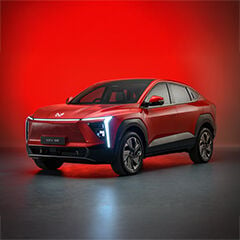
Mahindra to contest brand rights of BE 6e in court
Meanwhile, to name its Electric Origin SUV “BE 6”

29 Nov 2024
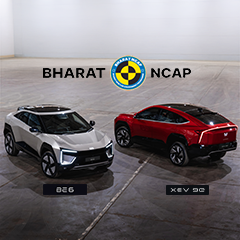
Unprecedented Safety of Mahindra eSUVs Demonstrated
Showcased: Live EV Crash and Battery Torture Tests

29 Nov 2024
Sonic Studio Experience by Mahindra
Immersive in-cabin audio experience in BE 6e & XEV 9e

26 Nov 2024
Mahindra's Electric Origin SUVs launched at Unlimit India
XEV 9e starts at Rs. 21.90 Lakh and BE 6e at Rs. 18.90 Lakh

22 Nov 2024
Mahindra Teases Sketches of BE 6e & XEV 9e
World Premiere at UNLIMIT INDIA, on 26th November in Chennai

21 Nov 2024
INGLO: Mahindra’s Electric Origin Architecture
XEV 9e & BE 6e World Premiere on 26th November in Chennai

04 Nov 2024
Mahindra debuts Electric Origin SUVs Named XEV 9e and BE 6e
World Premiere at UNLIMIT INDIA, on 26th November in Chennai

8 Jan 2025
New state-of-the-art EV manufacturing facility unveiled in Chakan
Next-gen EV plant to be dedicated for EV manufacturing & battery assembly