Why the XEV 9S Feels Different on Indian Roads
I have lived in multiple cities across India. You see, the advantage of living in different cities means I have been exposed to different kinds of roads – and no two Indian city has similar roads. I didn’t quite think it was that big an advantage until recently, when I had the opportunity to get behind the ’wheel of the new XEV 9S. Some found it wallowy, others found it plush. I thought it was clever. So, I spoke to R Velusamy, President – Automotive Business (Designate), Mahindra & Mahindra Ltd and Managing Director, Mahindra Electric Automobile Ltd. The man whose team engineered the XEV 9S.
Aninda Sardar (AS): I’ve just come back from driving it and I’m very curious to know what you have done to the suspension of the car because it felt really plush.
R Velusamy (RV): Sometimes big cars
help suspension. We have learnt that the hard way. The reason is, the heavy cars, when you have a right suspension, it’s not easy to unsettle it on an undulated surface. Because the body is heavy, it’s not going to dance. It also gives balance from the front of the vehicle to the rear of the SUV.
AS: How heavy is the XEV 9S?
RV: The kerb weight is about 2,270 (kilos). So it’s balanced and sits well on top of the front and rear axles and it’s stable. With a long wheelbase, it is stable. That’s one of the reasons. The second reason is when you apply the semi-active suspension, it is such a distributed system, it gives the best space to optimise between the dynamics and the ride.
How Semi-Active Suspension Works in the XEV 9S
AS: So how does a semi-active suspension work compared to say a regular suspension?
RV: So if all the four tyres move up and down simultaneously, the body does not roll. The body only compresses like a spring. And then the spring keeps on moving like this and the body keeps on moving up and down. Then you have a shock absorber that catches this movement and it allows once the spring is compressed and releases and then afterwards the shock absorber is holding the body straight. Now imagine this way, only one tyre is moving up, then the body rolls and compresses. To avoid the rolling, you want the spring to be stiffer. If it is stiffer, then the road inputs will come in. You will avoid the rolling, but the road inputs will come in. That is the basic reason why we have a softer spring, to have a pleasant ride. The reason why we have a spring is to isolate the hard inputs from the body. But the rolling problem is always pushing the spring to be a solid block. Interesting, very interesting. This is the battle that we have. The beauty is, it doesn’t happen all the time. So, when one tyre is moving down or up, immediately if you stiffen for that moment, for that fraction of second you have to stiffen it. And then release it. And then release it to normal, low spring rate.
AS: How do you do that?
RV: That’s where the semi-active suspension comes in. In 15 milliseconds, you have a displacement sensor in each wheel. So if the wheel is moving, and if the wheel goes into the pothole, or it moves over a bump, then it is measured. And as it measures, it sees a large deviation. It sends a signal to the ECU, suspension ECU, and then says, now I’m moving over. Please make the other side stiffer. And this entire thing happens in 15 milliseconds. And then when it crosses, when the tyre goes onto normal road, it releases.
Balancing Ride Comfort and Road Feedback
AS: It’s interesting because I was telling Pratap also during our interaction that when I was driving out of the hotel, took a right and there’s some undulation, right? I could feel that the undulations exist. But I could not feel, like there’s no sense of the undulation coming back to me. Like I know they’re there under the tyre, I can see that.
RV: Completely filtered. Completely isolated.
AS: But this degree of isolation, is it necessarily a good thing?
RV: Yes, it is a good thing. You don’t want the undulations to go to the seat. You want the undulations to come into the tyre. If you don’t get the undulations to the tyre, then you don’t have any grip. If you don’t have grip, you cannot accelerate, you cannot brake. So, they’re all linked. Never try and remove the undulations. So, the undulations have to exist, but they have to be isolated from the passenger.
How the XEV 9S Differs from the XEV 9e
AS: The other question that I have for you Velu is, this is obviously a little bit different from 9e, right? Have you had to do something differently from an engineering point of view for this?
RV: The tuning has to be done differently because the weight distribution, the body is different. So, due to the body height, the body rolls. The body front-rear distribution and the acceleration move. Longitudinal acceleration, when you accelerate, you are accelerating at seven seconds, which is about 0.4g. The platform moves forward. Right. And then the body tilts. This dynamic is different and it happens in milliseconds because the acceleration is very fast. When that acceleration is taking place, depending on how the body is moving, the speed at which you are stiffening the suspension will be different.
The Role of the INGLO Platform in Ride Dynamics
AS: What is the role of the INGLO platform itself? Does it provide you an advantage?
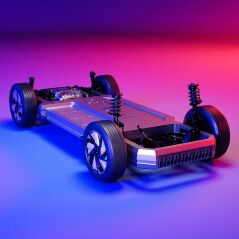
RV: So you get the common platform and then you tune it. It’s only software. So the hardware portion of the platform is a bit common but also a bit different. Depending on the top hat, you change the tuning calibration.
Tags
Mahindra XEV 9S, XEV 9S, Mahindra Electric SUVs, Mahindra Electric Origin SUVs, Electric SUV, Premium Electric SUV, INGLO Platform, Semi-Active Suspension, Suspension Technology, Vehicle Dynamics, Ride Quality, Ride Comfort
News and Press Releases
10 February 2026
Mahindra Scales Up Aftersales Service...
Mahindra Scales Up Aftersales Service Operations in Delhi NCR

14 January 2026
Mahindra XEV 9S and XUV 7XO record 93,689 Bookings
Booking Value of over ₹ 20,500 crore (*at ex-showroom price)

04 July 2025
Mahindra to Commence Deliveries of BE 6 and XEV 9e Pack Two from End-July
Now with both 59 kWh and 79 kWh battery options

9 Apr 2025
Mahindra Delivers 3000 All-Electric Origin SUVs Across India
Overwhelming response for both XEV 9e and BE 6
14 Feb 2025
Mahindra Electric Origin SUVs create new record in the EV category securing 30 179 bookings on day 1
Registered a booking value of ₹ 8472 crores (at ex-showroom price)

5 Feb 2025
Mahindra eSUVs to open bookings from 14th Feb, 2025
9 variants of the XEV 9e & BE 6 to be available for booking

14 Jan 2025
BE 6 makes its gaming debut in BGMI
KRAFTON X Mahindra redefine virtual engagement for gamers

7 Jan 2025
Prices for XEV 9e & BE 6 top variants announced
Test drives to begin from 14th January in select cities
7 Dec 2024
Mahindra to contest brand rights of BE 6e in court
Meanwhile, to name its Electric Origin SUV “BE 6”

29 Nov 2024
Unprecedented Safety of Mahindra eSUVs Demonstrated
Showcased: Live EV Crash and Battery Torture Tests

29 Nov 2024
Sonic Studio Experience by Mahindra
Immersive in-cabin audio experience in BE 6e & XEV 9e

26 Nov 2024
Mahindra's Electric Origin SUVs launched at Unlimit India
XEV 9e starts at Rs. 21.90 Lakh and BE 6e at Rs. 18.90 Lakh

22 Nov 2024
Mahindra Teases Sketches of BE 6e & XEV 9e
World Premiere at UNLIMIT INDIA, on 26th November in Chennai

21 Nov 2024
INGLO: Mahindra’s Electric Origin Architecture
XEV 9e & BE 6e World Premiere on 26th November in Chennai
04 Nov 2024
Mahindra debuts Electric Origin SUVs Named XEV 9e and BE 6e
World Premiere at UNLIMIT INDIA, on 26th November in Chennai

8 Jan 2025
New state-of-the-art EV manufacturing facility unveiled in Chakan
Next-gen EV plant to be dedicated for EV manufacturing & battery assembly